Give Your Negative Thoughts A Face
Give Your Negative Thoughts A Face 🌞
That voice in your head telling you you're stupid, annoying, not enough — it's not the truth. It's old programming. Smoke and mirrors. A tiny man behind a curtain with a microphone. In Daily Dose of Dawn #219, resilience coach Dawn Super uses the Wizard of Oz as a framework for understanding exactly what your negative self-talk actually is, where it came from, and the specific metacognition steps for dismissing it, replacing it, and eventually barely remembering it was ever there. This one is for the person who is doing the work and still finds themselves arguing with their own mind more than they'd like.
WATCH HERE or READ below
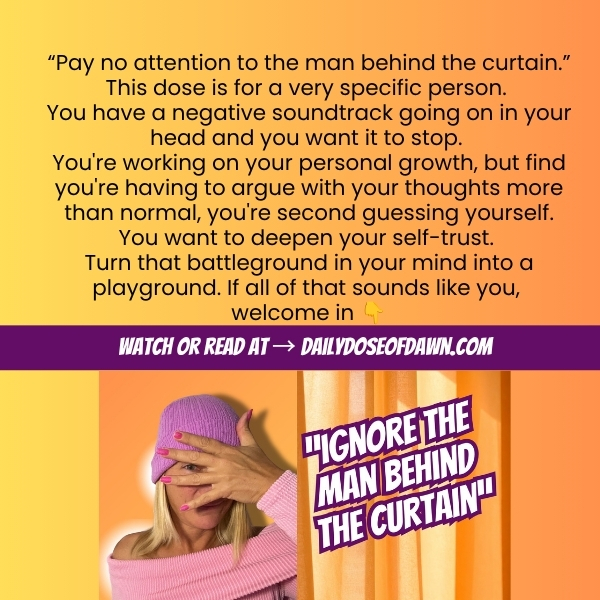
Pay no attention to the man behind the curtain. This dose is for a very specific person. You have a negative soundtrack going on in your head and you want it to stop. You're working on your personal growth, but find you're having to argue with your thoughts more than normal. Certain things happen and you're finding yourself second guessing yourself. You want to deepen your self-trust. Turn that battleground in your mind into a playground. And if all of that sounds like you, welcome in to your daily dose of Dawn at Dawn — videos designed to expand your thinking.
In the Wizard of Oz, there was this intimidating face, an intimidating voice, and it was all produced by a tiny little man behind a curtain. People got closer and kind of figured out it was him. He said on microphone, "Pay no attention to the man behind the curtain." But they could see it was coming from him.
When you have a negative thought in your head — "Oh my god, you're so stupid." "Geez, can you ever do anything right?" Or other not so nice things that you hear inside of your head that came out of someone else's mouth at some point or another.
Metacognition is thinking about your thinking. I call it surviving Tuesday.
I once had a partner who would say horrible things to me and I would take them home and pick them apart and analyze them and I would go back to them and I would say, "Listen, I don't agree with what you said because X, Y, and Z." And they said, "Oh, I didn't really mean it. I was just mad." I essentially wasted a couple of days and all of this time thinking about a problem that didn't even exist.
If you're living in a faulty meatsuit, if you had a traumatic upbringing, if you're dragging some baggage around with you — you're going to hear things differently than someone who isn't doing those things. So even just asking yourself some simple questions can help you process what it is that you're going through.
As your brain says, "Oh, you're so stupid" — if it's hard for you to dismiss it, ask yourself: would someone else say it was true? Why is it not true? Bring on some supporting evidence about why you're not stupid. What do you want to believe is true? That you misspoke? That you lacked a certain amount of knowledge to accomplish the thing? That you're just programmed to not say kind things to yourself?
"You're not good enough," "smart enough," "pretty enough."
I made notes for this video a couple of days ago and I'm actually really happy that it's been so long since I had a negative soundtrack that I kind of struggled to remember exactly what my brain used to say. But I know it wasn't good. "You're annoying" was like top of the list. "Nobody likes you." "You talk too much." Evidence proves that that's a lie.
So now what? I talk myself through it. Pay no attention to the man behind the curtain. It's all smoke and mirrors. The old program.
Each time you're faced with the old program, regulate yourself. The sooner you get to nervous system regulation, the sooner you can tell yourself what you'd like to have happen next time.
🧲 Hey, Dawn Super here. If you thrive on repetition, if you love little phrases to help you with your memory, and you're looking for effective tools to help you on your personal growth journey, take a second and check out my Fridge Philosophy magnets at happymatters.guru. Whether you're trying to survive starting over by yourself, working on ending generational trauma, trying to find your patience in an impatient world, or teaching your traumatized brain how to actually regulate your nervous system — because there's no reason that doing the work can't be fun. Okay, back to it.
Just a little side note here — there's a big difference between teasing, light-heartedly ribbing yourself and being self-deprecating. I'm definitely one to call myself ding-dong Dawn when I feel like I deserve it. It's a phrase I use to get grounded. And for me, it's affectionate.
If you need to get on top of being treated poorly, radical acceptance is a really good path to walk. "Wow, I was treated so badly." "Man, I'm glad that's over."
My client is going through learning nervous system regulation and now some of the things that she experienced when she was young are coming up — because she's a lot more prepared to deal with them. And holding your own hand through the things your mind brings to you is how you write a new program.
Your mind can become your best friend. And the first step towards that is telling it to shut up and then ignoring it. Telling it why it's a liar and what the truth actually is. Saying what you want to think, say, do instead — next time.
And what does that look like in real life? If I have some ghost feelings — which I very rarely do anymore — but if I do, I just confront them and I say, "Yeah, I know you had a hard time, but that was long ago. It is not now." And we can let it go. And we don't need to think that way.
And sometimes I just have to go take a nap.
🧲 Grab a Happy Matters Fridge Philosophy magnet — magnetize yourself to the life you want to be living: happymatters.guru
I have a five week program coming up that's going to help you learn to let go and then to also build yourself up.
Click the link below to get on the waitlst and receive an early bird discount when registration opens. https://dawnsuper.com/freeyourself
Click here to see more doses: https://DailyDoseofDawn.com