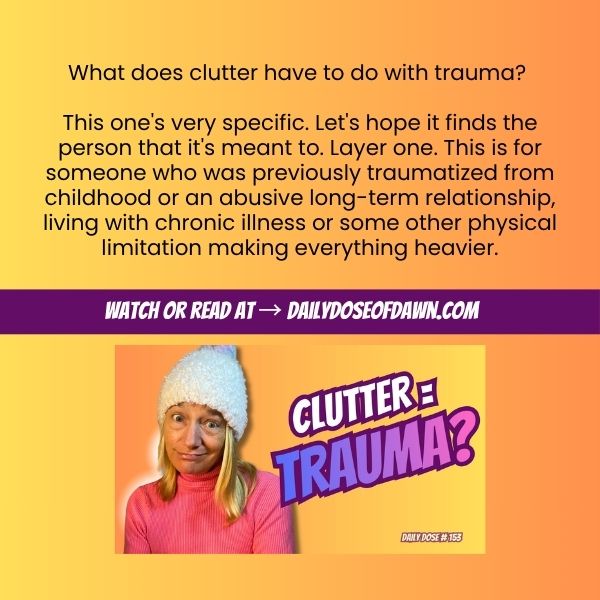
What Does Clutter Have to Do With Trauma? How to Let Go When Life Has Already Been Heavy | #158
If you've been through childhood trauma or an abusive relationship, live with chronic illness, and can't seem to get ahead of the mess in your home — this one is for you.
In Daily Dose of Dawn #158, Dawn connects the dots between trauma, physical limitation, and clutter in a way that finally makes the whole thing make sense. She shares her own story of going from borderline hoarder to committed minimalist — not by choice at first, but by necessity — and walks you through four practical steps to start letting go, even when everything feels heavy.
Watch the Video Here or Read the Script below
What does clutter have to do with trauma?
This one's very specific. Let's hope it finds the person it's meant to.
Layer one. This is for someone who was previously traumatized — from childhood or an abusive long-term relationship — and is living with chronic illness or some other physical limitation that makes everything heavier.
Layer two. This person is having a hard time keeping up with their home. They're doing everything they can, but it only seems to get messier. It's difficult to find things, and catching up feels impossible.
Layer three. This is starting to get into your head. You're looking around wishing you could make it all go away. You're ready for real change and need a sense of direction to move forward.
If all three of those layers apply to you, welcome in to your Daily Dose of Dawn — videos designed to expand your thinking.
So why do we want to think about this?
Your Earth school lesson is to learn to let clutter go — to become more minimalist with both your mental and physical homes. Unless you run into Marie Kondo or know Donna Barwald (hi Donna 👋), this connection isn't just going to come into your awareness on its own. You won't know to put two and two together.
So today we're going to walk through the four stages of learning: the noticing phase, learning how to minimize, and some strategies to help you actually take it on.
One of my business clients has several tons of old equipment sitting in the racking of his warehouse. He told me they've been dragging it around since 1992. That tracks with a lot of business owners I've consulted for. You keep it because you think it has value, or might someday, or because it's sentimental.
I get it. I raised three kids.
My rude awakening — the moment I realized I was a borderline hoarder — came after my first marriage ended. We had shared a three-bedroom house, a two-car garage, three kids, and two dogs. When it ended, I had to move into two rooms because that was all I could afford at the time.
What I didn't realize was that those two rooms were in the home of an actual hoarder.
Step one: Get rid of everything you can.
I never set out to become a minimalist. I just didn't have space to take it all, and I didn't have money to pay for storage. Honestly? That was the best thing that could have ever happened to me.
Step two: Learn how to live with less.
The two rooms I rented were tightly packed. After a year of that, when I got my next place — two small but actual bedrooms, plus other rooms — I had something I had never really had before.
Space.
I had been dragging things around with me since my teens.
Step three: Deeply understand why you want to do this.
Unless you're on board with your own ideas, you're not going to support them. I had the perspective of seeing just how dirty, cluttered, and icky it is to have a hoarder level of stuff in your house. You don't need to qualify for the TV show Hoarders to be making your life harder than it has to be.
At that point, I was also able to see the real benefit of having less — less on my mind, less on my body.
Step four: Create little ways to support yourself.
Say no to things people want to give you that you don't really need or want. Boundaries are very important in this process. Be grateful but firm.
"Oh, that's lovely. Thank you. But I'm a minimalist, so I'm going to pass."
People actually get impressed by that rather than offended.
Here's one more thing that helps: think about being in your casket.
Wow, Dawn. Okay.
I know, right? But go ahead — you got that visual. You in your casket. Do you see any knick-knacks in there with you? Any bags? Anything else?
No.
Good. It's not something you'll forget anytime soon. When you're trying to decide whether to get rid of something, go back to that visual. It'll help.
They say you can't take it with you. But everyone visualizes stuffing their suitcase for vacation — not the fact that none of us get out of this alive.
Dump the stuff. Stop adding new stuff. Fill your life with experiences and knowledge. Take pictures of everything you feel like you want to keep.
Just don't become a digital hoarder — because that's a thing too.
If you're ready to go deeper and need a little help, I've linked a video I did back in 2019 below: What Happens If I Don't Live With Clutter? It's full of tips. And I'm putting an updated version on my list for 2026 — if you want that, comment and let me know.
If you're still here watching this — you are the reason I do all of this. Well, I do it for me first. But after that, it's for you.
Thank you for staying till the end. I hope you take this and run with it.
Together, we all win.
Need help? check this out:
🔗 Want to go deeper? Get Dawn's 14-Day Self-Love Boot Camp: How to Be on Your Own Side — and if you can't afford it, reach out. She means it. 👉 https://howtobeonyourownside.com
📲 Ready for 1-on-1 coaching? A weekend slot is open. Text or call Dawn directly: 805-870-9740
Get the Dose delivered weekdays at 11:30 AM PST! By email or text.
Sign up here 👉👉👉 https://dawnsuper.com/joindose