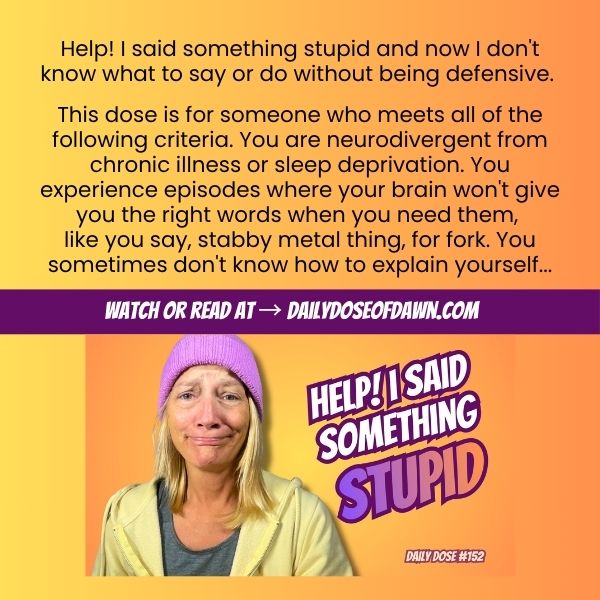
Help! I Said Something Stupid: How to Recover Without Getting Defensive When Your Brain Short-Circuits | #157
If you're neurodivergent, chronically ill, or running on sleep deprivation, there are days when your brain just won't cooperate — you say the wrong thing, you stare blankly, you lose the words entirely. And then comes the panic of not knowing how to fix it without making it worse.
In Daily Dose of Dawn #157, Dawn shares real-life strategies for recovering gracefully after those moments, drawn from her own experience and a client's story. No defensiveness required — just some practical tools for communicating more clearly when your brain is running on fumes.
Watch the Video Here or Read the Script below
Help! I said something stupid and now I don't know what to say or do without being defensive.
This Dose is for someone who meets all of the following criteria.
You are neurodivergent from chronic illness or sleep deprivation. You experience episodes where your brain won't give you the right words when you need them — like you say "stabby metal thing" for fork. You sometimes don't know how to explain yourself. And when you're more sleepy or in more pain, your brain can short-circuit and you stare at people like you forgot how to human.
Okay, that was super specific. Let's drill down one more layer.
You already notice this happens for you sometimes, and you're ready to try some coping strategies to communicate more clearly without being defensive — and level up in the life skills department.
If all that lines up for you, welcome in to your Daily Dose of Dawn — videos designed to expand your thinking.
This came up for my client in a conversation with a coworker, and for me with my son. So I thought I would share the solutions and help you expand your thinking — because we can do hard things. Oh yes, we can.
Cheers to my client, who honestly did the best thing she could do when her coworker gaslit her.
She stared at her for a beat, and without getting defensive, just apologized.
"Oh, sorry. I thought it was something else."
Done. Dusted. Over with.
Now, I hear you — "Dawn, that sounds like giving in and letting the coworker win."
Why yes. Yes it does. Because that's the best strategy for everyone to hold on to their peace. For real.
It doesn't cost anything to be wrong. Giving in equals peace. And peace is delicious — like dessert with no calories. All that's required is giving up your attachment to being right about it, and boom. Peace.
In my situation, it didn't go that way.
I asked my son to do something for me and he said he didn't want to. And I said, "How come you get to say no?" And then I just stared at him.
He looked offended. I was mentally out of gas. So I just patted his leg and said nothing.
The next day, when I was feeling better, I explained that I had asked him because I was very tired and couldn't do it myself — and I was too tired to communicate that to him effectively. I knew if I tried, I would probably just make it worse, because I was irritated. Irritated with him for saying no, and irritated with myself for not being able to do the thing.
That's a hard place to be. And it's a reality for millions of people living with chronic illness every day.
My chronic illness is not a free pass for me to be difficult or obnoxious to anyone.
So when I get to a place where I don't know how to communicate what I need or how I feel, I just go quiet. I don't want to make it worse.
The next day, when I was able to regulate better, I told him I was sorry — sorry for leaving him hanging like that overnight. And I explained that the reason why was because I didn't have enough capacity to handle it in the moment.
He appreciated me coming back. It gave him closure about something he wasn't sure how to process.
It's okay to come back after the fact and tell people what they couldn't perceive about what happened between you and them.
We often feel pressure to resolve everything immediately — especially if we are or were hypervigilant. One strategy that helps me through that is reminding myself: everything doesn't have to happen right now. I have time to figure it out, come back, and make it right.
So when you don't know what to say or do — especially if you don't have to — excuse yourself, regulate, regroup, and try again.
That is normal human behavior, even if you're neurospicy.
And if you're not sure what to do, you can always just say that:
"I'm having a hard time right now and I'm not sure what to do, so I'm just going to be quiet."
People appreciate that honesty. They know it's not them. They know they haven't done anything wrong.
Together, we all win.
🔗 Want to go deeper? Get Dawn's 14-Day Self-Love Boot Camp: How to Be on Your Own Side — and if you can't afford it, reach out. She means it. 👉 https://howtobeonyourownside.com
📲 Ready for 1-on-1 coaching? A weekend slot is open. Text or call Dawn directly: 805-870-9740