Yes, I Am Broken: Why "You're Not Broken" Triggers Chronically Ill People | Radical Acceptance vs. Toxic Positivity | #154
Discover why the phrase "you're not broken" triggers people with chronic illness and disabilities, and how to take your power back through radical acceptance with resilience coach Dawn Super's controversial perspective. This guide is for the one or two people irritated by toxic positivity phrases who are ready to explore why it triggers them and transmute that emotional pain into information.
Learn why denying you're broken means potentially driving your body into the ground, how accepting your "faulty meatsuit" is actually empowering, and why it's a triumph to do what "normies" do when you're held together by ingenuity and caffeine like MacGyver. Includes the powerful reframe: if a phrase rattles you, it owns you and lives rent-free in your head - negative emotions mean you're supposed to take action.
Discover the process of transmuting emotional pain by examining your reactions, running experiments on yourself, and making triggering phrases innocuous. Perfect for people with 9 disorders, multiple limitations, invisible illnesses, and anyone tired of being told they're "not broken" when they absolutely are - and that's okay.
Watch the Video Here or Read the Script below
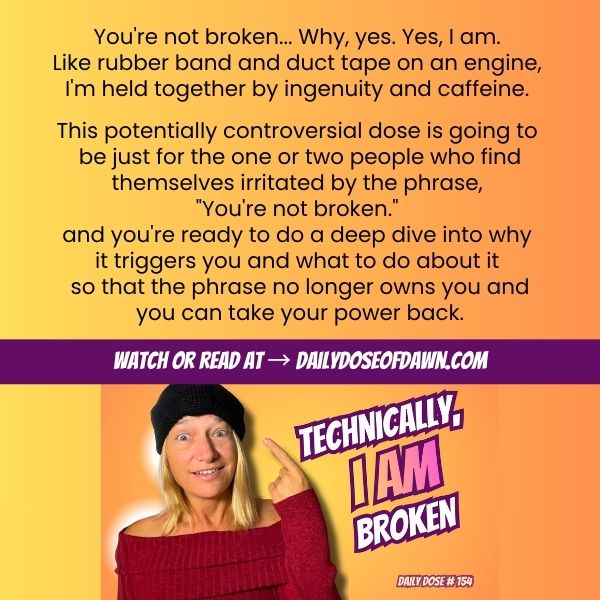
You're not broken.
Why, yes. Yes, I am.
Like rubber band and duct tape on an engine, I'm held together by ingenuity and caffeine.
This potentially controversial dose is going to be just for the one or two people who find themselves irritated by the phrase "You're not broken" - and you're ready to do a deep dive into why it triggers you and what to do about it so that the phrase no longer owns you and you can take your power back.
I know I can't be the only one who went through this.
So if I found you - welcome in to your Daily Dose of Dawn at Dawn, videos designed to expand your thinking.
Okay, broken one.
So why do we want to think about this?
Like I mentioned last week: If a phrase rattles you, it owns you. It lives rent-free in your head.
It took me 55 years to connect the dots that hearing words that upset me is having a negative emotion. And having a negative emotion means I'm supposed to take action.
Something is amiss. The lesson in Earth School has begun, and we need to figure out what to do about it.
Have you heard the word transmute?
I first heard it years ago and thought it was a funny word. It sounded so weird. I didn't even bother to learn the definition.
The fun thing was, I continued to do it even though I didn't know what it was called.
You've probably heard the word transcend, which is essentially "go beyond your limits."
Well, transmuting is similar, but it's emotional.
And you can teach yourself a process to transmute your emotional pain. And you take the emotional pain and you turn it into information by examining what was happening in my own mind as I process the information.
I essentially was able to run experiments on myself: Hear the phrase, examine what happened because I heard the phrase, and eventually make the phrase innocuous.
And this is where your true power lies.
So what does that look like in real life?
I hear the phrase "You're not broken," and I just say to myself: "Oh, that doesn't wash with me."
And that's it. I don't have any hard feels about it. It's like done with at that point.
Now, as to the specific phrase "you're not broken":
I believe loving the TV show MacGyver helped me a lot with this. Where's my Gen Xers at?
Something's broke? Let's MacGyver it.
Truth be told, I think that's how I got so far in life. I have nine disabling disorders, so many limitations.
I am a field-tested resilience coach, and my methods work - not just on me. They work because they get to the heart of what you're actually dealing with.
Ultimately, how I got through hearing the phrase and no longer being triggered - taking my power back - was with one of my absolute favorite coping strategies: radical acceptance.
Hearing the phrase "You're not broken" made me so mad because I certainly am.
If I can't accept that my meatsuit is broken, faulty, defective, or at the very least wired differently to other people's - I'm going to keep trying to drive it as if it's not.
Which means I'm going to run it into the ground, hurting myself even more - which is what I did for most of my life until I realized all of this stuff.
Finally, I took back the phrase: "Hey, this meatsuit can't do that. It's broken. I can come close, do half, do my version - but no, this isn't Nike, Becky. I can't 'just do it.'"
I don't run around saying I'm broken like I'm on Dr. Phil.
But when I read or hear "you're not broken" as a motivational tool, I just say: It's okay to be broken. Most of us are broken in some way. It's nothing to be ashamed of. There's no need for hard feels.
To me, it's a triumph if I can do the same thing as a normie in this faulty meatsuit.
It's like winning the race in that MacGyvered vehicle held together with a hat, some glitter, and a will to serve the world.
Want to learn more about narcolepsy?
Here's a video I did for rare disease day: