What You Think About, You Bring About? Here's What It Actually Means | #141
What does the phrase “what you think about, you bring about” really mean? In this Daily Dose, resilience coach Dawn Super breaks down the mindset behind this popular saying in a practical, non-woo-woo way. Learn how paying attention to what’s on your mind can help you regulate your mood, reclaim your power, and show up for your life with greater emotional awareness.
Watch the Video Here or Read the Script below
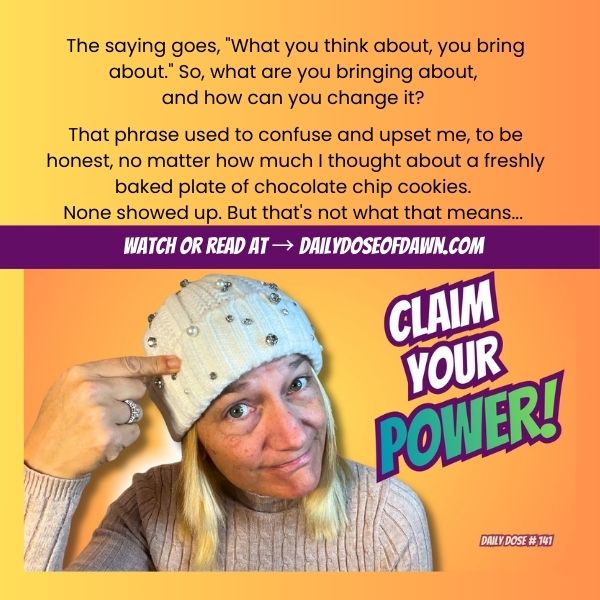
The saying goes, "What you think about, you bring about." So, what are you bringing about, and how can you change it?
That phrase used to confuse and upset me, to be honest, no matter how much I thought about a freshly baked plate of chocolate chip cookies. None showed up. But that's not what that means.
This is the daily dose of Dawn at Dawn. Videos designed to expand your thinking.
So why did I want to think about this? Because I didn't want the phrase to own me. I was getting triggered every time I heard someone say, "What you think about you bring about." So I set out to understand it and to own it.
I'm really excited to see more daily dosers showing up every day. What we're talking about here is important and it's not talked about in school. So it gives us a chance to be exposed to it so that we can think about it and when we're faced with it know what to do.
So what does it mean to not want a phrase to own you? Well, it means if someone says the phrase, the mere mention of it affects me, I'm giving away my power to the phrase.
Getting upset means you're pausing your immune system and that affects your physiology.
In day five of my book, How to Be on Your Own Side, I take on mindfulness, which I loosely define simply as what's on your mind.
Okay?
So, without getting into any like serious or woo woo comparisons, breaking it down, the "what you think about you bring about"…
For me, the way I distilled it was:
If I think about good things, I feel good.
If I think about hard things, bad things, I feel bad.
That's a super simplification.
And I'm not doing that 24 hours a day, 7 days a week.
I'm doing it if I notice I'm in a mood.
If I don't feel like myself, if I feel bad and I'm not sure why.
So when that happens, I ask myself:
Is what's on my mind right now good?
If it's not, can I make it good?
And if it's good, can I make it better?
It's not about forcing positivity.
It's about showing up for yourself.
Life is easier when you feel good.
And it's easier when you comfort yourself if you don't feel good.
One of the most important first steps on my personal growth journey was realizing that what was going on in my mind was holding me back for most of my life.
I needed to learn the skills that helped me stay on my own side.
Staying positive without being toxic about it.
Stopping people pleasing.
And being mindful of what's going through my head at any given moment.
And I put 14 of those key skills into my book, How to Be on Your Own Side.
So, if you're ready to get fully on your own side and be your own bestie, just pop on over to howtobeonyourownside.com and check it out.