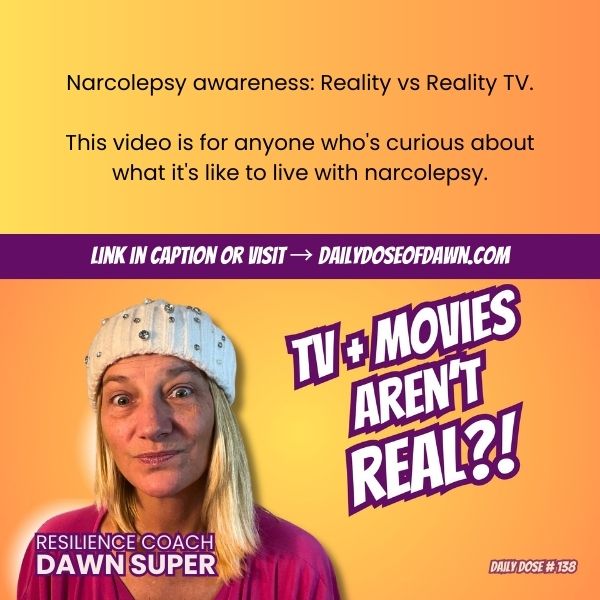
Narcolepsy: What TV Gets Wrong (Reality vs Reality TV) | #138
What is it really like to live with narcolepsy? In this Daily Dose, resilience coach and narcolepsy advocate Dawn Super shares the difference between Hollywood portrayals and real-life narcolepsy. Learn about cataplexy, emotional triggers, sleep deprivation, and why empathy and regulation matter more than reacting to misinformation.
Watch the Video Here or Read the Script below
Narcolepsy awareness: Reality versus reality TV.
This video is for anyone who's curious about what it's like to live with narcolepsy.
This is the Daily Dose of Dawn at Dawn, videos designed to expand your thinking.
So why do we want to think about this? Because empathy is the glue that holds us all together. We all want to be understood and awareness helps with that, especially when it comes to something as rare as narcolepsy. Plus, millions of people are sleep deprived and narcolepsy is still very underdiagnosed.
Welcome back to my Happy Matters Collective where we're living with hard things while also believing that happy matters.
Happy is a helper feel like gratitude or compassion. It comes in to help us hold our hand through the hard stuff. We're not happy because we want to sugarcoat anything. We're happy because it makes our nervous system stronger and it helps us deal with the challenges that come at us in life.
I'm not just a resilience coach. I'm also a narcolepsy advocate. And I am an advocate because I've been living with narcolepsy for over 40 years.
Whatever you've seen presented in film about narcolepsy is most likely not accurate. But I was watching a movie with my kids the other night and what's depicted about bank robberies isn't really accurate either. Or surgical procedures. Or legal situations. Parenting. Biking. Deep sea diving. You get it. It's not real. TV and movies, they're not real. Even reality TV is scripted.
You'll see characters in reality TV that are supposed to be real people, but they either have something about them that isn't factual, they're acting, or something along those lines.
It's easy to get upset when we see something depicted incorrectly, but it's very important that we regulate ourselves because getting upset about things just tanks us even more.
For me, it was a double-edged sword because I have cataplexy, which is a physical response to an emotional response. So irrational situations are one of my triggers. When something irrational would happen, my knee would give out or something would happen.
Cataplexy is when the brain puts some-to-all of your body to sleep in response to an emotional stimulus.
So something would happen and my elbow would dip or my knee would give out. And it also taxes my body.
Because I talk about my narcolepsy in public, I have people make uneducated or misinformed statements.
As an example, someone recently said to me, “I wish I had that,” because they needed a nap.
A long time ago, that would have triggered me and I would have gotten mad and lashed out at the person. But I just told them they were being rude. They probably didn't even know they were being rude, evidenced by the “Really?” when I said that.
So it gives you an opportunity to educate someone.
Saying that you want my debilitating disease because you're tired… is rude.
If you don't know what to say, it's best to just not say anything at all or to say, “I feel for you.” Simple.
Narcolepsy doesn't give you the luxury of skipping the nap. If you need a nap and you fight it off, your brain will take the nap whether you comply with it or not. And that's what makes narcolepsy so challenging.
Sleep deprivation is used as torture because it's torturous. It's effective. It breaks down the mind.
After four decades with narcolepsy, I have to do mental gymnastics sometimes to negotiate with myself.
I recently had someone tell me if I cried it out “properly,” my narcolepsy would go away. And just for the sake of narcolepsy awareness, it doesn't work like that.
It's okay that people don't understand. It's more important that I control what happens inside of me while this is happening.
Whether you have narcolepsy or diabetes or some other quirk or health issue that you get sensitive about, how you deal with the way people come to you about it matters more than what they think or how they feel.
Think about it. If I had let myself get upset about the comment that guy made, I would have needed a nap myself. That would have impacted the rest of my day.
This is why Happy Matters has been so beneficial for me and for the people that I've taught how to live this way.
The most important thing I'll leave you with about narcolepsy is that no two people with narcolepsy have it exactly the same.
There may be some common symptoms. Some may have some. Some have others.
So whether you know someone or heard of someone or saw it on television, do not assume you know about the person you're talking to who actually has narcolepsy, because no two people are the same.
I'll leave you with my basic rule for narcolepsy or literally anything in life: Unless it's a documentary, don't get your knowledge from movies or reality TV.
If you’re tired of getting upset by what people say — or feeling misunderstood all the time — my book How to Be on Your Own Side helps you stop spiraling and start steadying yourself.
In just 14 days, you’ll feel calmer in your own skin, clearer in what to say, and far less thrown off by other people’s ignorance.
You can’t control what they say.
But you can decide how long it lives in your head.
Start there.


